
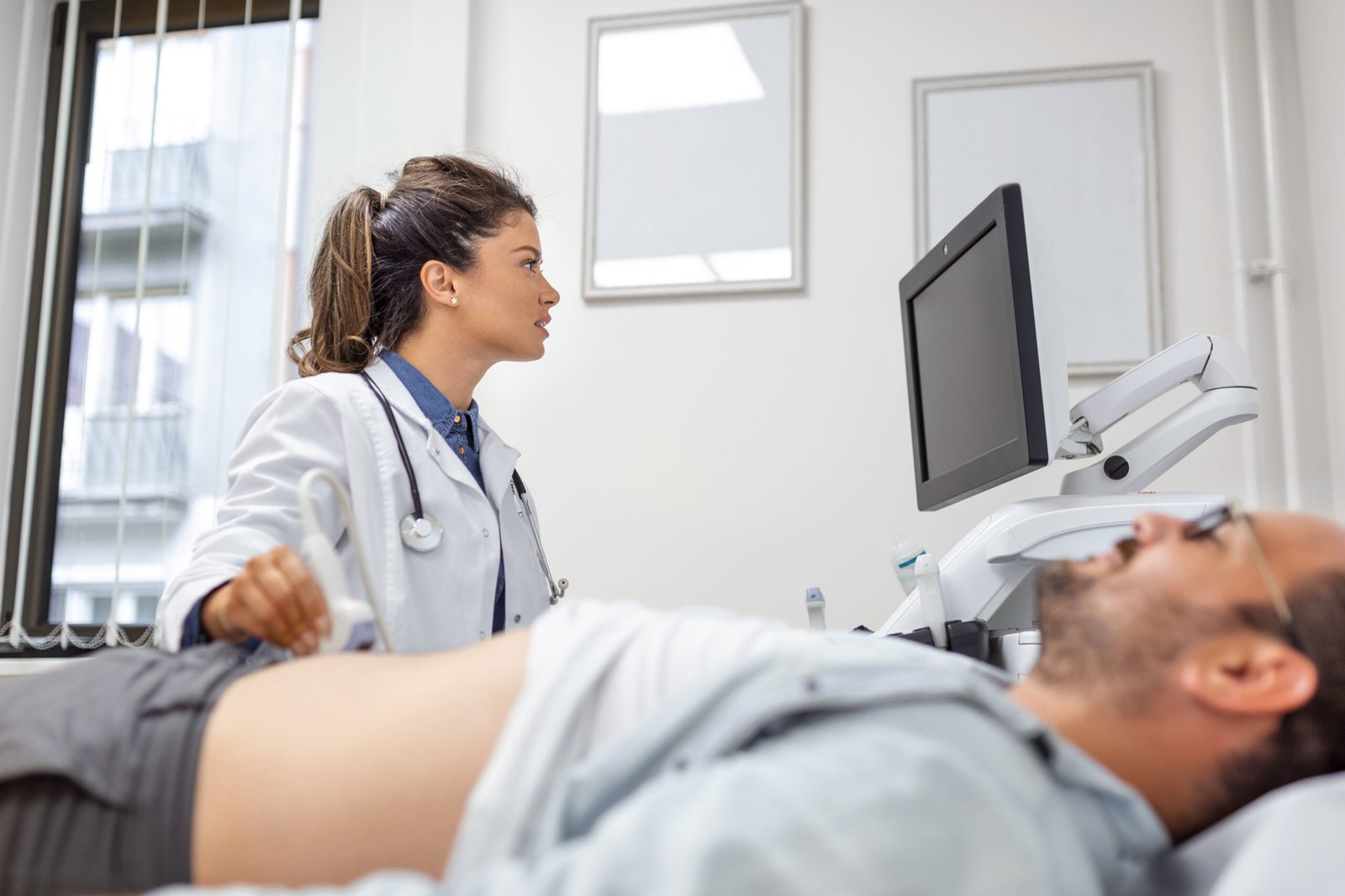
A FibroScan is a quick, non-invasive test that measures liver stiffness and, when available, liver fat without requiring needles, incisions or a liver biopsy.
Doctors may recommend FibroScan for people with fatty liver disease, abnormal liver enzymes, chronic hepatitis, or other conditions that can affect the liver.
At Exact Check Diagnostic Center, FibroScan testing provides measurements that your physician can use together with your medical history, blood tests and other examinations to assess your liver health.
What Does a FibroScan Measure?
FibroScan uses a technology called transient elastography. A probe placed against the skin sends a small mechanical pulse through the liver and measures how the resulting wave travels through the tissue.
The examination can provide two important measurements.
1. Liver Stiffness Measurement
Liver stiffness is usually reported in kilopascals (kPa).
In general, increased liver stiffness can be associated with fibrosis, or scarring of the liver.
Fibrosis can develop when the liver is repeatedly injured or inflamed over time. More advanced fibrosis can eventually progress to cirrhosis.
However, a FibroScan result should not be interpreted on its own. Liver stiffness can be affected by several factors, and the significance of a particular result depends on the underlying liver condition and the patient's overall clinical picture.
2. Controlled Attenuation Parameter (CAP)
When CAP measurement is available, FibroScan can also estimate the amount of fat within the liver, known as hepatic steatosis.
CAP is generally reported in decibels per meter (dB/m).
Higher CAP measurements can be associated with greater amounts of liver fat. Your physician will interpret the measurement in the context of your other test results and medical history.
What Is Fibrosis?
Liver fibrosis is the formation of scar tissue after repeated or ongoing injury to the liver.
Early fibrosis may not cause noticeable symptoms. If liver injury continues, fibrosis can progress and eventually lead to cirrhosis, an advanced stage of liver scarring.
FibroScan helps physicians assess liver stiffness without immediately resorting to an invasive procedure such as liver biopsy.
It does not, however, diagnose every liver condition or replace all other liver tests.
What Is Fatty Liver Disease or MASLD?
Metabolic dysfunction-associated steatotic liver disease (MASLD) is a condition in which excess fat accumulates in the liver in association with metabolic risk factors.
MASLD is the newer terminology for what was previously commonly called non-alcoholic fatty liver disease (NAFLD).
Some people with liver fat remain stable, while others may develop inflammation and fibrosis over time. Because fatty liver disease may cause few or no symptoms, it is often discovered through blood tests or imaging performed for another reason.
Who May Need a FibroScan?
Your doctor may recommend a FibroScan if you have a condition or risk factor associated with liver disease.
This may include people with:
- Known or suspected fatty liver disease or MASLD
- Persistently elevated liver enzymes
- Type 2 diabetes or metabolic syndrome
- Obesity or other metabolic risk factors
- Chronic hepatitis B or hepatitis C
- Alcohol-related liver disease
- A known liver condition requiring monitoring
- Other findings that suggest possible liver fibrosis
Having one of these risk factors does not automatically mean that you need a FibroScan. Your physician can determine whether the test is appropriate for you.
FibroScan vs. Liver Ultrasound: What's the Difference?
FibroScan and a conventional abdominal or liver ultrasound can both provide useful information, but they are not the same test.
| FibroScan | Liver Ultrasound |
| Measures liver stiffness | Creates images of liver anatomy |
| Can provide a CAP measurement associated with liver fat | Can identify structural abnormalities and features associated with fatty liver |
| Helps assess possible fibrosis | Evaluates the liver's size, shape and appearance |
| Provides numerical measurements | Primarily provides anatomical images |
| Uses transient elastography | Uses diagnostic ultrasound imaging |
Depending on your condition, your physician may request one or both examinations.
FibroScan vs. Liver Biopsy: What's the Difference?
A liver biopsy involves removing a small sample of liver tissue so that it can be examined under a microscope.
FibroScan does not remove tissue. Instead, it provides non-invasive measurements that can help estimate liver stiffness and steatosis.
For many patients, non-invasive tests can provide useful information about liver health. However, FibroScan does not completely replace liver biopsy. There are circumstances in which a physician may still recommend a biopsy or additional testing.
What Happens During a FibroScan?
A FibroScan examination is straightforward and does not require anesthesia.
During the test:
- You will lie on an examination bed, usually on your back.
- You may be asked to position your right arm above your head.
- The healthcare professional will expose a small area on the right side of your abdomen.
- Gel will be applied to the skin.
- The FibroScan probe will be positioned over the liver area.
- The device will take a series of measurements.
You may feel a gentle tapping or vibration from the probe as measurements are taken.
The examination itself is generally brief, although your total visit may include registration, preparation and review of your information.
Is a FibroScan Painful?
FibroScan is non-invasive and generally painless.
There are no incisions and no tissue samples are removed. Most patients experience only the sensation of the probe against the skin and a mild tapping feeling during measurements.
Do I Need to Fast Before a FibroScan?
Patients are commonly given fasting instructions before FibroScan because eating can affect liver stiffness measurements.
Follow the specific preparation instructions provided by Exact Check for your examination, including how long you should avoid food before your appointment.
If you take regular medication or have a medical condition that affects fasting, ask your physician or the Exact Check team for instructions rather than changing your medication schedule on your own.
How Long Does a FibroScan Take?
The measurement portion of a FibroScan examination is generally brief.
Your total appointment time may be longer to allow for registration, preparation and positioning.
When booking, ask Exact Check how much time you should allow for your visit.
What Do My FibroScan Results Mean?
Your FibroScan report may include a liver stiffness measurement in kPa and, when applicable, a CAP measurement in dB/m.
It can be tempting to search for a single “normal FibroScan score,” but results are not interpreted using one universal cutoff for every patient.
The meaning of your measurements can vary depending on factors including:
- The underlying liver condition
- Your medical history
- Other laboratory and imaging results
- Technical factors affecting the examination
Your FibroScan results should therefore be interpreted by your physician together with your other clinical information.
Can FibroScan Diagnose Fatty Liver or Cirrhosis?
FibroScan provides information that can help physicians assess liver fat and fibrosis, but the measurements should not be considered a standalone diagnosis.
Your doctor may combine FibroScan results with:
- Liver function and other blood tests
- Medical history and physical examination
- Ultrasound or other imaging
- Other non-invasive fibrosis assessments
- Liver biopsy when clinically necessary
This combination gives your physician a more complete picture of your liver health.
FibroScan at Exact Check Diagnostic Center
Exact Check Diagnostic Center provides FibroScan testing for liver stiffness and liver fat assessment.
Before your visit, contact Exact Check to:
- Confirm FibroScan availability at your preferred branch
- Ask about the current FibroScan price
- Confirm fasting and preparation requirements
- Check whether you need a doctor's request
- Ask what documents or previous results to bring
- Check appointment availability
- Confirm when and how your results will be released
Schedule Your FibroScan
If your doctor has requested a FibroScan, contact Exact Check Diagnostic Center to confirm availability, preparation requirements, pricing and appointment schedules.
If you are concerned about fatty liver, abnormal liver enzymes or your risk for liver disease but have not been advised to undergo FibroScan, speak with your physician about which tests are appropriate for you.
This article is intended for general educational information and does not replace medical advice, diagnosis or treatment from a qualified healthcare professional.