
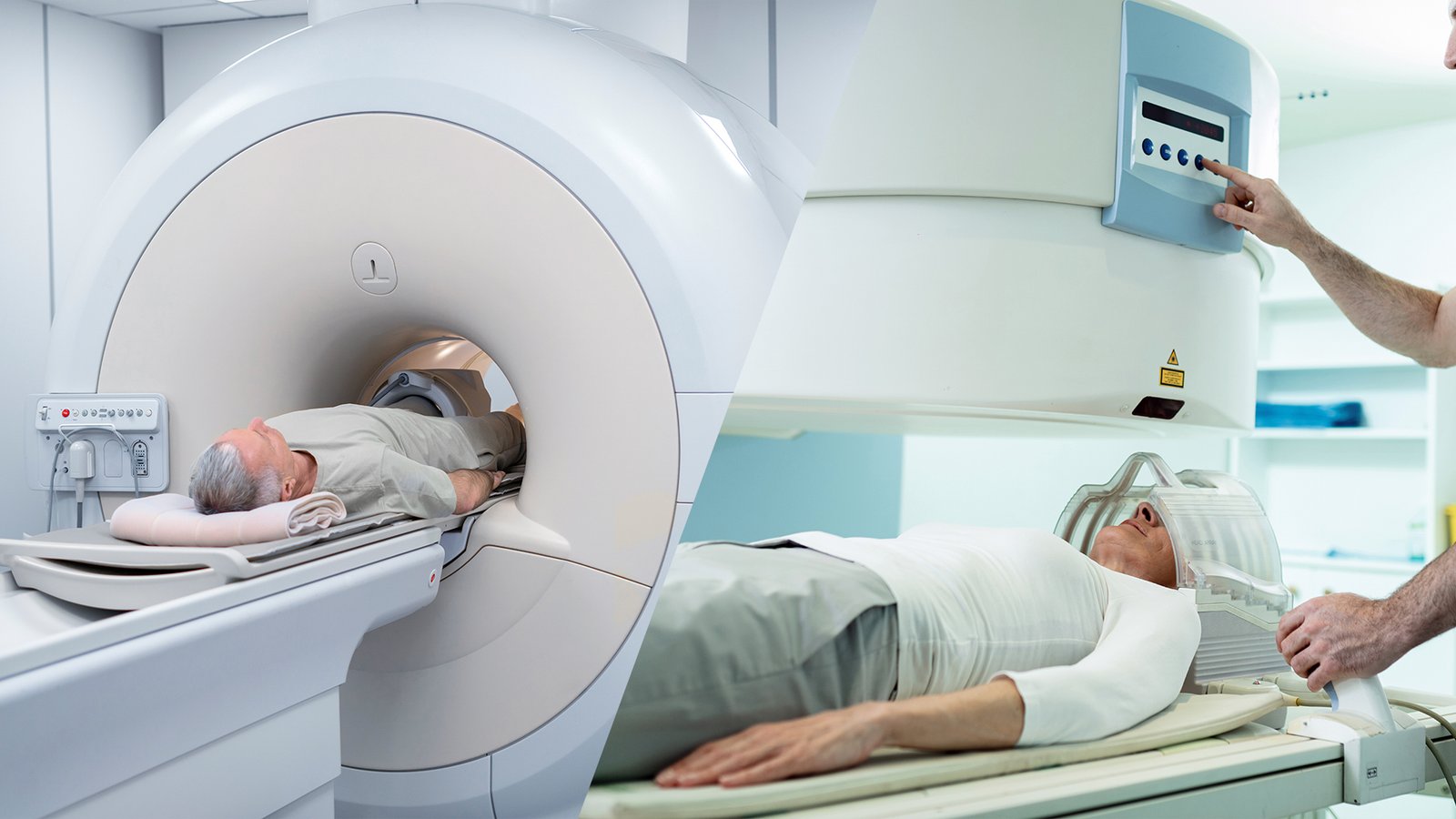
CT scans and MRI scans both create detailed images of structures inside the body, but they use different technologies and are suited to different diagnostic questions.
A CT scan uses X-rays, while an MRI uses a strong magnetic field and radio waves. CT examinations are generally faster and are commonly used to evaluate the lungs, bones, abdominal conditions and acute injuries. MRI can provide greater soft-tissue contrast for certain examinations of the brain, spine, joints and other structures.
So which one do you need?
That decision should generally be made by your physician based on your symptoms, medical history and the part of the body that needs to be examined.
What Is a CT Scan?
A CT scan, or computed tomography scan, uses X-rays and computer processing to create detailed cross-sectional images of the body.
CT can provide information about:
- Bones
- Lungs
- Internal organs
- Blood vessels
- Soft tissues
- Areas of internal bleeding or injury
Depending on the examination, a CT scan may be performed with or without contrast.
CT examinations are generally relatively quick, which is one reason they are frequently used when imaging is needed urgently.
What Is an MRI?
MRI, or magnetic resonance imaging, uses a strong magnetic field and radiofrequency energy to produce detailed images of structures inside the body.
Unlike CT, MRI does not use ionizing radiation.
MRI can provide particularly detailed images of certain soft tissues and is commonly used to evaluate areas including:
- Brain
- Spinal cord
- Spine
- Joints
- Ligaments and tendons
- Muscles
- Certain internal organs and soft tissues
MRI examinations generally take longer than CT examinations and require the patient to remain still during image acquisition.
CT Scan vs. MRI: What's the Difference?
Here are some of the main differences between CT and MRI.
| CT Scan | MRI | |
| Technology | X-rays | Magnetic field and radiofrequency energy |
| Ionizing radiation | Yes | No |
| Examination time | Generally faster | Generally longer |
| Bones and fractures | Often very useful | Useful for certain bone and bone-marrow conditions |
| Lungs | Commonly used | More limited for routine lung imaging |
| Brain and nervous system | Useful, particularly in certain urgent situations | Often provides greater soft-tissue detail |
| Joints, ligaments and tendons | Useful in selected cases | Commonly used for detailed soft-tissue evaluation |
| Internal organs | Commonly used | Also used depending on the organ and clinical question |
| Metal implants/devices | Generally less restrictive | Some implants or devices require MRI safety assessment |
| Claustrophobia | Usually less challenging because of the scanner design and shorter examination | May be more difficult for patients uncomfortable in enclosed spaces |
| Contrast | May use iodinated contrast | May use gadolinium-based contrast |
Neither test is universally “better.” The appropriate examination depends on what your physician needs to investigate.
When Might a Doctor Choose a CT Scan?
A physician may request CT when rapid, detailed imaging is needed or when CT is particularly well suited to the body area or suspected condition.
Examples include evaluation of:
- Certain head injuries
- Suspected acute bleeding
- Lung conditions
- Kidney stones
- Bone fractures
- Abdominal or pelvic pain
- Certain vascular conditions
- Trauma involving multiple areas of the body
The exact CT examination and whether contrast is required will depend on the clinical indication.
When Might a Doctor Choose an MRI?
MRI may be selected when detailed soft-tissue imaging is particularly important.
Examples include evaluation of certain conditions involving:
- Brain
- Spinal cord
- Spine
- Ligaments and tendons
- Joint cartilage
- Muscles
- Certain pelvic structures
- Other soft tissues
MRI is also useful in situations where avoiding ionizing radiation is an important consideration, although this does not automatically mean MRI is the appropriate alternative to CT.
Which Is Better for the Brain: CT or MRI?
Both can be used to examine the brain, but they answer different clinical questions.
CT is frequently used in urgent situations, such as certain head injuries or when acute intracranial bleeding is suspected, because images can be obtained quickly.
MRI can provide more detailed soft-tissue information for many neurological conditions.
Your physician will select the appropriate examination based on your symptoms and how urgently imaging is needed.
Which Is Better for the Lungs: CT or MRI?
CT is commonly used for detailed imaging of the lungs and chest.
It may be requested to investigate lung nodules, certain infections, chest abnormalities and other pulmonary conditions.
MRI has important applications in chest imaging but is not generally the first imaging method used for routine evaluation of lung tissue.
Which Is Better for Bones and Joints?
For many fractures and detailed bone anatomy, CT can provide excellent visualization.
For ligaments, tendons, cartilage, bone marrow and other soft tissues around joints, MRI may provide more useful information.
This is why two patients with pain in the same general area may be referred for different imaging examinations depending on the suspected problem.
Does CT or MRI Use Radiation?
A CT scan uses ionizing radiation because it produces images using X-rays.
An MRI does not use ionizing radiation. It creates images using a strong magnetic field and radiofrequency energy.
Radiation exposure from CT varies according to the type of examination and imaging protocol.
Your physician considers the expected diagnostic benefit when deciding whether CT imaging is appropriate.
CT Contrast vs. MRI Contrast: Are They the Same?
No.
When contrast is required, CT and MRI generally use different types of contrast agents.
CT commonly uses an iodinated contrast agent, while MRI may use a gadolinium-based contrast agent.
Not every CT or MRI requires contrast.
Before receiving contrast, tell your healthcare team about relevant medical conditions, previous reactions to contrast agents and other information they request.
Which Is Faster: CT or MRI?
CT examinations are generally faster than MRI examinations.
The actual image acquisition for some CT examinations can be very quick, although the total appointment includes registration, preparation, positioning and contrast administration when required.
MRI examinations commonly take longer because multiple imaging sequences may need to be obtained.
Actual examination times vary considerably depending on the body area and protocol.
Which Is Better If I'm Claustrophobic?
Patients with claustrophobia may find MRI more challenging because many MRI examinations require spending a longer period within the scanner.
CT scanners typically have a shorter, ring-shaped opening, and CT examinations are generally quicker.
If you are concerned about claustrophobia, tell the imaging facility before your examination so you can discuss what to expect.
Can I Have an MRI If I Have Metal in My Body?
It depends on the type of implant, device or metal.
Because MRI uses a powerful magnetic field, the imaging team must assess whether certain implanted devices or metallic objects are safe for the examination.
Before an MRI, tell the healthcare team if you have:
- A pacemaker or other implanted cardiac device
- A cochlear implant
- Surgical clips
- Metal fragments
- An implanted pump or stimulator
- Joint replacements or other implanted hardware
- Any other medical implant or device
Do not assume that having an implant automatically prevents you from having MRI. Many modern devices may be MRI-compatible or MRI-conditional, but this must be verified by the imaging team.
What If I'm Pregnant?
Tell your physician and the imaging facility if you are pregnant or think you may be pregnant before undergoing either examination.
Because CT uses ionizing radiation and MRI has its own safety considerations, your physician will determine which imaging approach is appropriate based on the clinical need and your individual circumstances.
Is CT or MRI More Accurate?
There isn't a useful universal answer.
CT may provide better information for one condition while MRI may provide better information for another.
“Accuracy” depends on:
- The body part being examined
- The suspected condition
- The imaging protocol
- Whether contrast is needed
- The clinical question your physician is trying to answer
Rather than asking which technology is more advanced, the more useful question is:
Which imaging examination provides the information my doctor needs for this particular problem?
Can I Choose Between a CT Scan and MRI?
Generally, you should not substitute one imaging test for another without discussing it with your physician.
If your doctor has requested a CT scan, there is usually a clinical reason that CT was selected. Likewise, an MRI request contains information about the type of imaging your physician believes is appropriate.
If you're unsure why a particular examination was ordered, ask your physician before changing the requested test.
CT Scan at Exact Check Diagnostic Center
Exact Check Diagnostic Center provides CT scan services for patients who require diagnostic imaging.
Before your visit, contact Exact Check to:
- Confirm that the CT procedure requested by your physician is available
- Ask whether your examination requires contrast
- Check preparation requirements
- Ask about the current CT scan price
- Confirm what documents or laboratory results you need to bring
- Check appointment availability
- Confirm when and how your results will be released
Schedule Your CT Scan
If your physician has requested a CT scan, contact Exact Check Diagnostic Center to confirm the procedure, preparation requirements, pricing and available schedules.
Bring your doctor's request or referral when applicable so our team can confirm the appropriate imaging examination.
This article is intended for general educational information and does not replace medical advice, diagnosis or treatment from a qualified healthcare professional.