
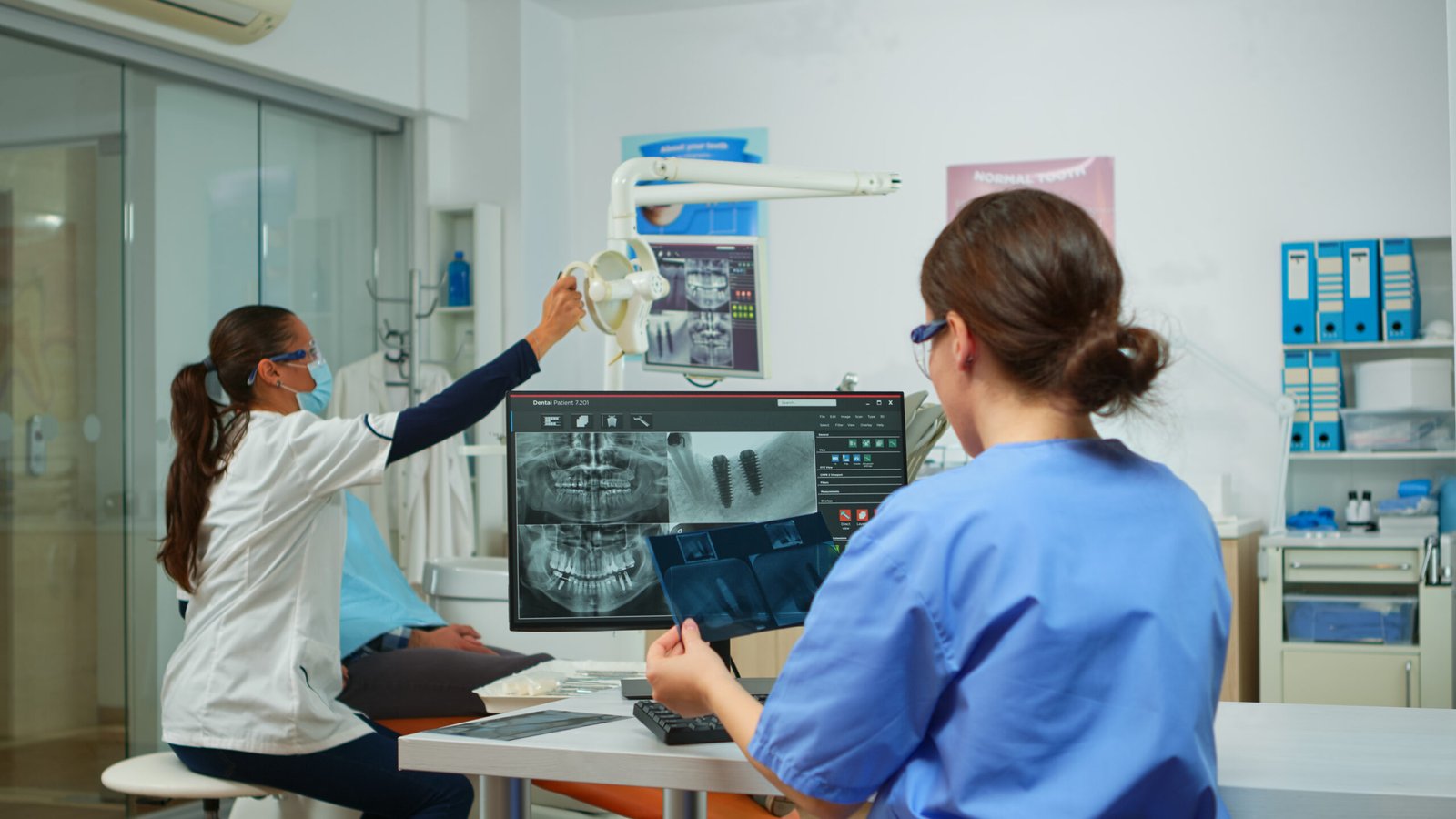
If you're considering a dental implant, your dentist or oral surgeon will need imaging to evaluate the area where the implant may be placed.
A panoramic dental X-ray, also called a panorex or panoramic radiograph, provides a broad two-dimensional view of the teeth, upper and lower jaws, and surrounding structures. It can be useful during the initial assessment for dental implants.
However, a panoramic X-ray does not provide the same three-dimensional information as a CBCT scan. Depending on your case, your dentist may request additional imaging before planning or performing implant surgery.
At Exact Check Diagnostic Center, panoramic dental X-rays are available for patients who have been referred for dental and oral surgery assessment.
Why Is Imaging Needed Before a Dental Implant?
A dental implant is placed into the jawbone to support a replacement tooth or dental prosthesis.
Before implant treatment, the dentist or oral surgeon needs to evaluate the proposed implant site and surrounding structures.
Imaging may help assess:
- The general condition of the jawbone
- The location of missing teeth
- Adjacent tooth roots
- The approximate position of important anatomical structures
- Existing dental conditions
- Areas that may require more detailed evaluation
The type of imaging required depends on the location and complexity of the proposed implant.
What Can a Panoramic X-Ray Show Before Dental Implant Treatment?
A panoramic X-ray captures both jaws and the teeth in a single image.
For implant assessment, it can provide an initial overview of several important areas.
1. General Jawbone Anatomy
A panoramic X-ray allows the dentist to examine the general appearance and height of the jawbone in the area of a missing tooth.
This can help identify areas that may require further evaluation before implant treatment.
However, because panoramic X-rays are two-dimensional, they cannot accurately show the full three-dimensional width and volume of the jawbone.
2. Adjacent Teeth and Tooth Roots
Panoramic imaging can show the general position of teeth and roots surrounding the proposed implant site.
This information helps the dentist understand the overall dental anatomy and identify findings that may need further assessment.
3. The Inferior Alveolar Canal
For implants in the lower jaw, the dentist needs to consider the location of the inferior alveolar canal, which contains an important nerve and blood vessels.
A panoramic X-ray can provide a general view of the canal's course.
For cases requiring precise three-dimensional assessment of the relationship between the proposed implant and the nerve canal, additional imaging such as CBCT may be required.
4. The Maxillary Sinuses
For implants involving the upper back teeth, the position of the maxillary sinus can affect treatment planning.
A panoramic X-ray provides a general view of the relationship between the sinus and the upper jaw.
If more detailed assessment is required, the dentist or oral surgeon may request three-dimensional imaging.
5. Other Dental or Jaw Findings
Because a panoramic X-ray captures a broad area, it may reveal other findings that could affect treatment planning, including:
- Impacted teeth
- Retained tooth roots
- Areas of dental infection
- Certain jaw abnormalities
- Other findings requiring dental evaluation
If something requires closer examination, additional dental imaging may be recommended.
Can a Panoramic X-Ray Measure Bone for a Dental Implant?
A panoramic X-ray can provide useful information about general bone height and anatomy, but it has limitations for precise implant measurements.
Because the image is two-dimensional and can have magnification or distortion, it does not provide a direct three-dimensional measurement of bone width.
For this reason, dentists may use additional imaging when precise measurements are required for implant planning.
Panoramic X-Ray vs. CBCT for Dental Implants
This is an important distinction for patients considering implant treatment.
| Panoramic X-Ray | CBCT |
| Produces a 2D image | Produces 3D imaging data |
| Shows both jaws in one broad image | Provides detailed views from multiple planes |
| Useful for an initial overview | Often used for detailed implant planning |
| Shows the general location of teeth, jaws, sinuses and nerve canals | Can provide more detailed assessment of bone dimensions and anatomical relationships |
| Does not directly show three-dimensional bone width | Provides three-dimensional information about the implant site |
A panoramic X-ray and CBCT are not interchangeable.
Your dentist or oral surgeon will determine which imaging examination is appropriate for your particular implant case.
Do I Need a CBCT Before Getting a Dental Implant?
Not every patient has exactly the same imaging requirements.
Your dentist or oral surgeon will decide whether a panoramic X-ray provides sufficient information for the stage of your assessment or whether CBCT or another imaging examination is needed.
Factors that can affect this decision include:
- Implant location
- Available bone
- Proximity to nerves or sinuses
- Number of implants planned
- Previous dental procedures
- Complexity of the case
- Other clinical findings
Follow the imaging request provided by your dentist rather than choosing the examination yourself.
Why Does Bone Matter for Dental Implants?
Dental implants depend on adequate supporting bone.
After a tooth is lost or extracted, changes in the surrounding jawbone can occur over time. The amount and pattern of bone change varies between patients.
If your dentist determines that there may not be sufficient bone for the planned implant, additional evaluation or procedures such as bone grafting may be discussed.
Imaging is one part of that assessment.
What Happens During a Panoramic Dental X-Ray?
A panoramic dental X-ray is taken from outside the mouth and is generally painless.
During the examination:
- You may be asked to remove eyeglasses, earrings, necklaces and other metal objects around your head and neck.
- You will stand or sit at the panoramic X-ray machine.
- The technologist will position your head and ask you to bite gently on a positioning guide.
- You will remain still while the imaging unit rotates around your head.
- The digital image will then be available for review according to the facility's release process.
The actual image acquisition is brief, although your total visit also includes registration and positioning.
Do I Need to Prepare for a Panoramic X-Ray?
Panoramic dental X-rays generally require minimal preparation.
You can usually eat, drink and take your normal medications before the examination unless you have been given different instructions for another procedure.
Tell the imaging facility if you are pregnant or think you may be pregnant before undergoing an X-ray examination.
Bring your dentist's or oral surgeon's imaging request so the team can confirm the examination that has been prescribed.
Can I Send My Panoramic X-Ray to My Dentist?
Digital panoramic images can generally be provided for your dentist or oral surgeon to review.
Ask Exact Check when booking:
- How your images will be released
- What digital format is provided
- Whether images can be sent electronically
- When the images or report will be available
Your dentist will use the imaging together with your dental examination and other clinical information to determine the next steps.
Panoramic Dental X-Ray at Exact Check Diagnostic Center
Exact Check Diagnostic Center provides digital panoramic dental X-ray services for patients undergoing implant assessment and other dental evaluations.
Before your visit, contact Exact Check to:
- Confirm panoramic X-ray availability
- Ask about the current panoramic X-ray price
- Check whether an appointment is required
- Confirm what you need to bring
- Ask how your digital images will be provided
- Confirm when your images or results will be available
Schedule Your Panoramic Dental X-Ray
If your dentist or oral surgeon has requested a panoramic dental X-ray before implant treatment, contact Exact Check Diagnostic Center to confirm availability, pricing and appointment schedules.
Bring your dentist's imaging request when applicable so our team can confirm the examination you need.
This article is intended for general educational information and does not replace professional dental or medical advice.