
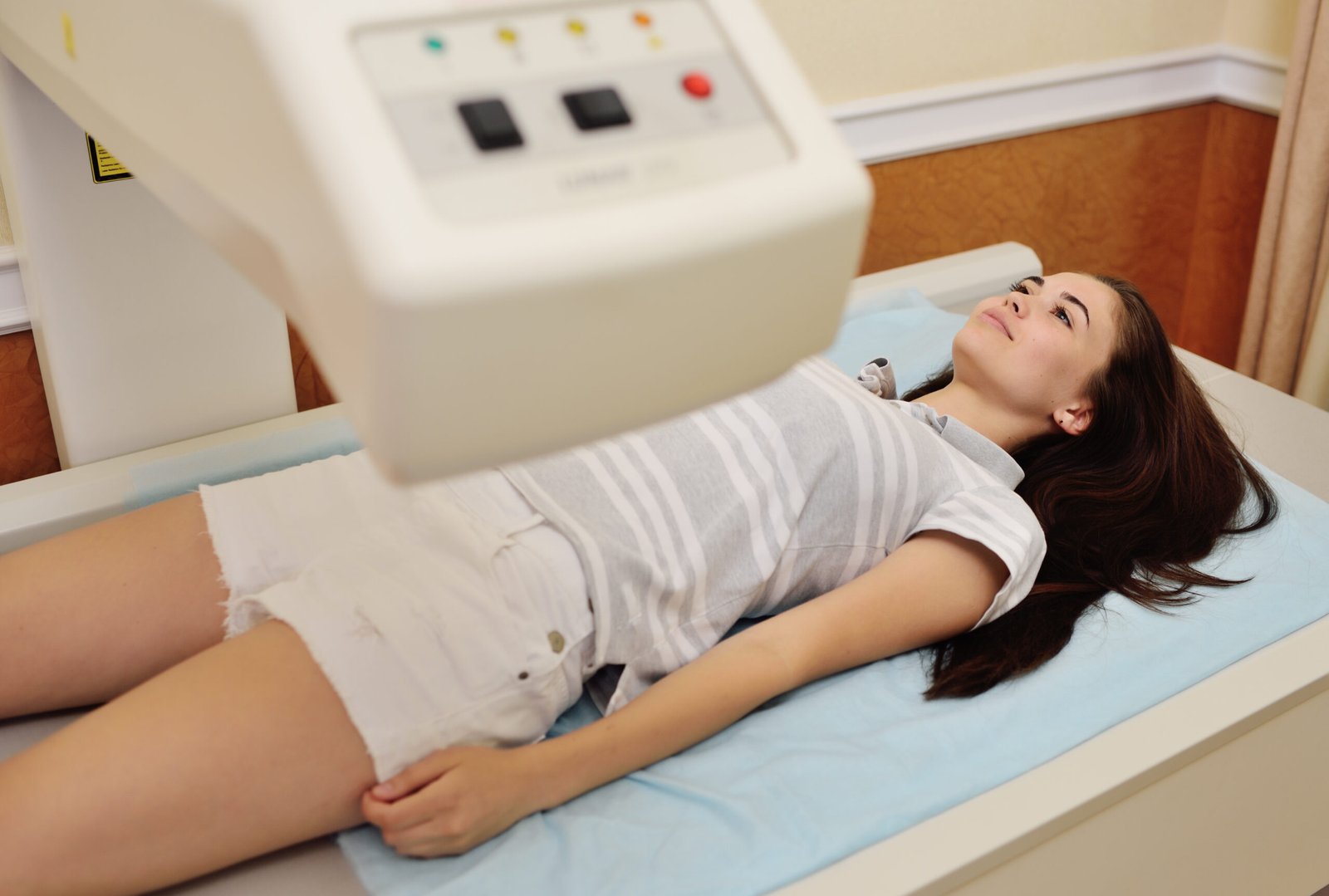
If you've received the results of a DEXA or DXA bone density scan, you may see terms such as T-score, Z-score, osteopenia, and osteoporosis on your report.
What do these numbers actually mean?
A DEXA scan measures bone mineral density (BMD), usually at areas such as the hip and lumbar spine. Your results help your physician assess your bone health and fracture risk together with your age, medical history, medications, previous fractures, and other risk factors.
At Exact Check Diagnostic Center, bone densitometry provides measurements that your physician can use to evaluate and monitor your bone health.
What Does a DEXA Scan Measure?
DEXA, also written as DXA, stands for dual-energy X-ray absorptiometry.
The examination uses low-dose X-rays to measure bone mineral density. The hip and lumbar spine are commonly measured because fractures in these areas can have significant health consequences.
Your report may include:
- Bone mineral density or BMD
- T-score
- Z-score
- Measurements from different areas of the hip and spine
- A general classification of your bone density
The significance of these results depends partly on your age, sex, and individual medical circumstances.
What Is a T-Score?
A T-score compares your bone mineral density with that of a healthy young adult reference population.
For postmenopausal women and men aged 50 and older, T-scores are commonly interpreted using the following classifications:
| T-Score | General Classification |
| -1.0 or above | Normal bone density |
| Between -1.0 and -2.5 | Low bone mass or osteopenia |
| -2.5 or below | Osteoporosis |
For example, a T-score of -0.7 falls within the normal range, while a T-score of -1.8 falls within the low bone mass or osteopenia range.
A T-score of -2.5 or lower meets the bone-density criterion for osteoporosis in the populations for whom T-score classification is appropriate.
However, your T-score should not be interpreted in isolation.
What Does a Negative T-Score Mean?
Seeing a negative number on your DEXA report can look alarming, but a negative T-score does not automatically mean you have osteoporosis.
A T-score indicates how your bone mineral density compares with the young-adult reference population.
The further the number falls below zero, the lower the measured bone mineral density relative to that reference.
For example:
- T-score -0.5: generally within the normal range
- T-score -1.5: generally classified as low bone mass or osteopenia
- T-score -2.0: generally classified as low bone mass or osteopenia
- T-score -2.5: meets the bone-density criterion for osteoporosis
- T-score -3.0: falls within the osteoporosis range
These examples explain the classifications, but they do not provide a complete assessment of an individual's fracture risk.
What Is Osteopenia?
Osteopenia, also called low bone mass, describes bone mineral density that is lower than the normal reference range but does not meet the T-score threshold for osteoporosis.
A T-score between -1.0 and -2.5 generally falls within this category for postmenopausal women and men aged 50 and older.
Having osteopenia does not necessarily mean that you will develop osteoporosis.
Your physician will consider other factors that can affect your risk of fracture, including:
- Age
- Previous fractures
- Family history
- Body weight
- Smoking
- Alcohol consumption
- Certain medications
- Medical conditions associated with bone loss
- Risk of falling
Some people with osteopenia may have a higher overall fracture risk than others despite having similar T-scores.
What Is Osteoporosis?
Osteoporosis is a condition characterized by reduced bone strength and an increased risk of fracture.
For postmenopausal women and men aged 50 and older, a T-score of -2.5 or below at an appropriate measurement site meets the bone-density criterion for osteoporosis.
However, bone density is only one part of osteoporosis assessment.
A physician may also consider previous fragility fractures, medical history, medications and other clinical risk factors when evaluating osteoporosis and deciding whether treatment is appropriate.
What Is a Z-Score?
A Z-score compares your bone mineral density with what's expected for people of a similar age and sex.
Unlike a T-score, which compares your results with a young-adult reference population, the Z-score provides an age-matched comparison.
Z-scores are particularly relevant when evaluating bone density in:
- Premenopausal women
- Men younger than 50
- Certain younger patients
A Z-score that is substantially lower than expected for age may prompt a physician to investigate whether an underlying medical condition, medication or other factor could be affecting bone health.
T-Score vs. Z-Score: What's the Difference?
The easiest way to understand the two scores is to look at who you're being compared with.
| T-Score | Z-Score | |
| Compared with | Healthy young-adult reference population | People of similar age and sex |
| Commonly used for | Postmenopausal women and men 50+ | Younger adults and certain other patients |
| Used in osteoporosis classification | Yes, in appropriate populations | Generally not used in the same way |
| Main purpose | Helps classify bone mineral density | Shows whether BMD is lower than expected for age |
Your physician will determine which measurement is most relevant to your situation.
Why Are My Hip and Spine T-Scores Different?
It's common for DEXA reports to show different bone density measurements at different sites.
For example, your hip T-score may be lower or higher than your lumbar spine T-score.
Bone loss does not necessarily occur at exactly the same rate throughout the skeleton. Measurements can also be influenced by anatomical and technical factors.
Your physician will review the relevant measurement sites and determine how the overall results should be interpreted.
Do not simply average your hip and spine T-scores yourself.
Does a Low T-Score Mean I Will Break a Bone?
No.
A lower bone density is associated with increased fracture risk, but DEXA cannot predict with certainty whether an individual person will experience a fracture.
Your physician may also consider:
- Your age
- History of previous fractures
- Family history of hip fracture
- Smoking
- Alcohol consumption
- Certain medications
- Medical conditions
- Fall risk
- Other clinical factors
In appropriate patients, fracture-risk assessment tools may also be used alongside bone-density results.
Can My T-Score Improve?
Bone mineral density can change over time.
Depending on the cause of low bone density and the individual patient's circumstances, changes may occur following:
- Osteoporosis treatment
- Appropriate nutrition
- Weight-bearing and resistance exercise
- Management of an underlying medical condition
- Changes in medications affecting bone health
- Other interventions recommended by a physician
However, small differences between two DEXA scans do not necessarily represent a meaningful biological change.
Your physician can determine whether a change between examinations is significant.
How Much Change in My DEXA Result Is Significant?
This is an important question when comparing repeat bone density scans.
DEXA measurements have a degree of normal measurement variability. Therefore, a small increase or decrease in BMD does not automatically mean that your bones have meaningfully improved or worsened.
When monitoring bone density, clinicians may consider whether the difference exceeds the least significant change (LSC) established for the testing facility and equipment.
This is one reason follow-up DEXA results should be interpreted by a healthcare professional rather than by comparing T-scores alone.
Should I Compare My New DEXA Scan With My Previous One?
Yes. Previous bone density results can provide useful information when your physician is monitoring changes over time.
If possible, bring your previous DEXA reports when undergoing follow-up testing.
Comparison may help your physician assess whether your bone density appears to be:
- Stable
- Increasing
- Decreasing
For monitoring purposes, consistency in the measurement site, equipment and testing facility can sometimes make comparison more useful.
How Often Should a DEXA Scan Be Repeated?
There is no single repeat-testing interval appropriate for everyone.
Your physician may consider:
- Your initial DEXA results
- Age
- Osteoporosis risk factors
- Previous fractures
- Medications
- Medical conditions
- Whether you are receiving osteoporosis treatment
- Whether repeat testing is likely to change your medical management
Some people may need follow-up testing sooner than others.
Follow the schedule recommended by the physician managing your bone health rather than automatically repeating DEXA every year.
What Should I Ask My Doctor About My DEXA Results?
When reviewing your bone density report with your physician, useful questions include:
- What do my T-score and Z-score mean for me?
- Do I have normal bone density, osteopenia or osteoporosis?
- Which measurement site is most important in my case?
- What is my overall fracture risk?
- Do I need treatment or lifestyle changes?
- Could a medication or medical condition be affecting my bones?
- Do I need additional laboratory tests?
- When should I have another bone density scan?
The goal isn't simply to improve a number on your report. It's to understand your overall bone health and fracture risk.
Bone Densitometry at Exact Check Diagnostic Center
Exact Check Diagnostic Center provides DEXA bone densitometry testing for patients who need osteoporosis screening, fracture-risk assessment or bone-density monitoring.
Before your visit, contact Exact Check to:
- Confirm DEXA availability at your preferred branch
- Ask about the current bone densitometry price
- Confirm whether you need a doctor's request
- Check preparation requirements
- Ask whether you should bring previous DEXA results
- Check appointment availability
- Confirm when and how your results will be released
Schedule Your Bone Density Test
If your physician has requested a DEXA scan, contact Exact Check Diagnostic Center to confirm availability, preparation requirements, pricing and appointment schedules.
If you already have your DEXA results, discuss your T-score, Z-score and other findings with your physician rather than relying on any single number to assess your fracture risk.
This article is intended for general educational information and does not replace medical advice, diagnosis or treatment from a qualified healthcare professional.