
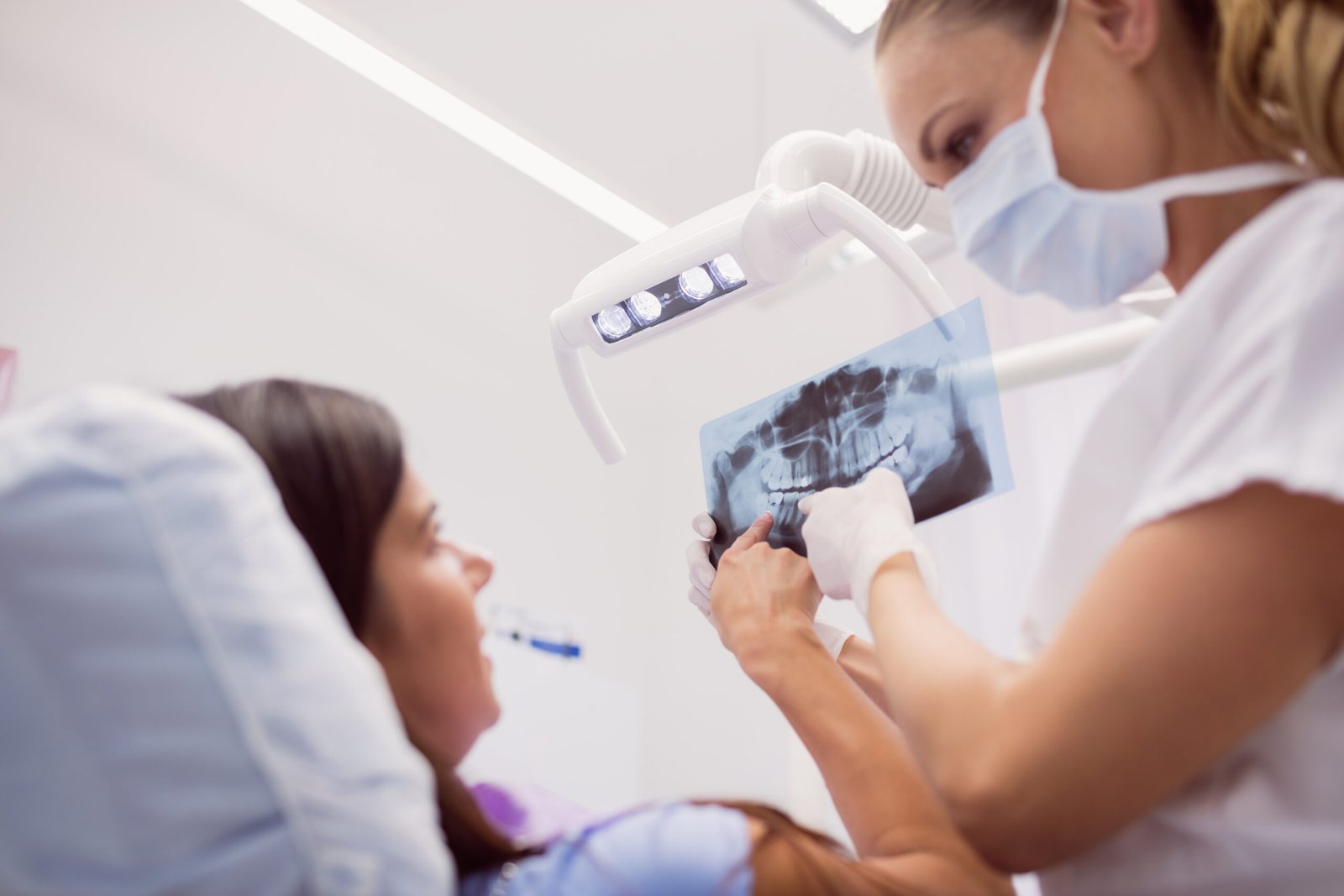
How often do you need dental X-rays? The answer depends on your oral health, age, symptoms, dental history and risk for conditions such as tooth decay and gum disease.
Not everyone needs a dental X-ray every year, and a panoramic dental X-ray (panorex) serves a different purpose from bitewing and periapical X-rays.
Your dentist will determine which type of dental X-ray you need and when it should be performed based on the information required for your care.
At Exact Check Diagnostic Center, we provide dental imaging services for patients who have been advised to undergo X-rays as part of their dental or orthodontic evaluation.
Why Do Dentists Take Dental X-Rays?
A visual dental examination provides important information about your teeth and gums, but some structures cannot be fully evaluated by looking inside the mouth alone.
Dental X-rays can help dentists evaluate areas including:
- The spaces between teeth
- Tooth roots
- Bone surrounding the teeth
- Teeth that have not yet erupted
- Impacted teeth
- Developing permanent teeth
- Certain abnormalities within the jaw
The type of X-ray requested depends on what your dentist needs to examine.
How Often Should You Get Dental X-Rays?
There is no single dental X-ray schedule appropriate for everyone.
Your dentist may consider factors such as:
- Your age
- Current oral health
- History of cavities or gum disease
- New dental symptoms
- Previous dental treatment
- Presence of impacted or unerupted teeth
- Orthodontic treatment
- Other individual risk factors
Someone with active dental problems may require imaging more frequently than someone with good oral health and a low risk of dental disease.
The goal is to obtain X-rays when they are expected to provide useful diagnostic information, rather than taking the same X-rays automatically every year.
What Is a Panoramic Dental X-Ray?
A panoramic dental X-ray, also known as a panorex or panoramic radiograph, captures a broad two-dimensional image of the teeth, upper and lower jaws and surrounding structures.
Unlike smaller dental X-rays that focus on a few teeth at a time, a panoramic X-ray provides an overview of a much larger area in a single image.
It can be particularly useful when a dentist needs to assess overall dental development, tooth position or structures within the jaws.
What Can a Panoramic X-Ray Show?
A panoramic X-ray can provide useful information about several dental and jaw conditions.
Impacted Teeth
Panoramic imaging can show teeth that have not erupted normally, including impacted wisdom teeth and canine teeth.
It allows the dentist or oral surgeon to assess the general position and orientation of these teeth and determine whether further evaluation or treatment may be necessary.
Wisdom Teeth
A panorex can show whether wisdom teeth have developed, whether they are impacted and how they are positioned relative to surrounding structures.
However, the presence of wisdom teeth does not automatically mean they need to be removed. Your dentist or oral surgeon will determine whether treatment is necessary.
Developing Teeth
In children and teenagers, panoramic imaging can provide an overview of permanent teeth that are still developing beneath the gums.
It may help identify:
- Unerupted permanent teeth
- Missing teeth
- Additional teeth
- Certain developmental abnormalities
Jaw Abnormalities
Because a panoramic X-ray includes a broad view of the jaws, it may reveal certain abnormalities involving the jawbone.
If an unusual finding is identified, your dentist may recommend additional or more detailed imaging to investigate it further.
Bone Supporting the Teeth
Panoramic images provide a general overview of the bone surrounding the teeth.
However, other dental X-rays and clinical measurements may be more appropriate when a dentist needs a detailed assessment of periodontal or gum disease.
Temporomandibular Joints
The temporomandibular joints, or TMJs, are visible on panoramic images.
A panoramic X-ray can provide a general view of these structures, but it cannot diagnose every cause of TMJ pain or dysfunction. Additional clinical evaluation or imaging may be necessary depending on the symptoms.
Panoramic X-Ray vs. Bitewing X-Ray: What's the Difference?
Panoramic and bitewing X-rays provide different information.
| Panoramic X-Ray | Bitewing X-Ray |
| Shows a broad overview of the teeth and jaws | Shows a smaller group of upper and lower teeth |
| Useful for impacted and unerupted teeth | Particularly useful for detecting decay between teeth |
| Shows overall tooth development and position | Provides greater detail of tooth crowns and supporting bone in a specific area |
| Captures both jaws in one image | Usually requires several individual images |
| Common in orthodontic and surgical assessment | Common in routine dental evaluation when clinically indicated |
One is not simply “better” than the other. Your dentist selects the imaging examination based on the clinical question that needs to be answered.
Panoramic X-Ray vs. Periapical X-Ray
A periapical X-ray provides a detailed image of one or several teeth, including the crown, root and surrounding bone.
A panoramic X-ray covers a much larger area but provides less fine detail of individual teeth.
A dentist may request a periapical X-ray when investigating a particular tooth, root or localized dental problem.
Do I Need a Panoramic X-Ray Every Year?
Not necessarily.
There is no general requirement for every patient to undergo a panoramic X-ray annually.
Your dentist will decide when another panoramic image is appropriate based on your oral health, previous images, symptoms and treatment needs.
If your dentist already has a recent panoramic X-ray, another may not be necessary unless there has been a change in your condition or additional information is needed.
Do I Need a Panoramic X-Ray Before Braces?
Orthodontists commonly use panoramic imaging as part of an orthodontic assessment because it provides an overview of tooth roots, unerupted teeth, wisdom teeth and jaw structures.
Depending on your case, your orthodontist may also request a cephalometric X-ray or other imaging for treatment planning.
[Learn more about why panoramic X-rays are used before orthodontic treatment.]
What Happens During a Panoramic Dental X-Ray?
A panoramic dental X-ray is taken from outside the mouth.
During the examination:
- You may be asked to remove eyeglasses, jewelry and other metal objects around your head and neck.
- You will stand or sit at the panoramic X-ray unit.
- The technologist will position your head and ask you to bite gently on a positioning guide.
- You will need to remain still.
- The X-ray unit will rotate around your head while the image is acquired.
The actual image acquisition is brief, although your total visit also includes registration and positioning.
Is a Panoramic Dental X-Ray Painful?
No. A panoramic dental X-ray is non-invasive and generally painless.
Nothing needs to be inserted deep inside your mouth, although you may be asked to bite gently on a positioning guide to help keep your head correctly aligned.
Are Dental X-Rays Safe?
Dental X-rays use ionizing radiation.
Dentists request imaging when the expected diagnostic benefit justifies the radiation exposure and select the examination appropriate for the patient's needs.
Tell your dentist and the imaging facility if you are pregnant or think you may be pregnant before undergoing an X-ray examination.
Which Dental X-Ray Do I Need?
You generally shouldn't choose the type of dental X-ray yourself.
Your dentist or orthodontist may request:
- Panoramic X-ray
- Bitewing X-rays
- Periapical X-rays
- Cephalometric X-ray
- Other dental or maxillofacial imaging
Each examination provides different information.
If you already have a dentist's request but aren't sure which examination to book, Exact Check can review the request and help confirm the procedure prescribed.
Panoramic Dental X-Ray at Exact Check Diagnostic Center
Exact Check Diagnostic Center provides panoramic dental X-ray and other diagnostic imaging services for patients referred by dentists, orthodontists and other healthcare professionals.
Before your visit, contact Exact Check to:
- Confirm panoramic X-ray availability
- Ask about the current panorex price
- Check whether an appointment is required
- Confirm what you need to bring
- Ask how your digital images or results will be released
- Confirm whether the dental X-ray requested by your dentist is available
Schedule Your Panoramic Dental X-Ray
If your dentist or orthodontist has requested a panoramic dental X-ray, contact Exact Check Diagnostic Center to confirm availability, pricing and appointment schedules.
Bring your dentist's request when applicable so our team can help confirm the correct imaging procedure.
This article is intended for general educational information and does not replace professional dental or medical advice.